
The Horizon Europe project BERTHA (BEhavioural Replication of Human drivers for CCAM) presented its results at its final event on 21 October 2026 in Brussels. The event brought together researchers, industry, policymakers and mobility stakeholders to review the project’s achievements and discuss the next steps towards human-centred automated mobility in Europe.
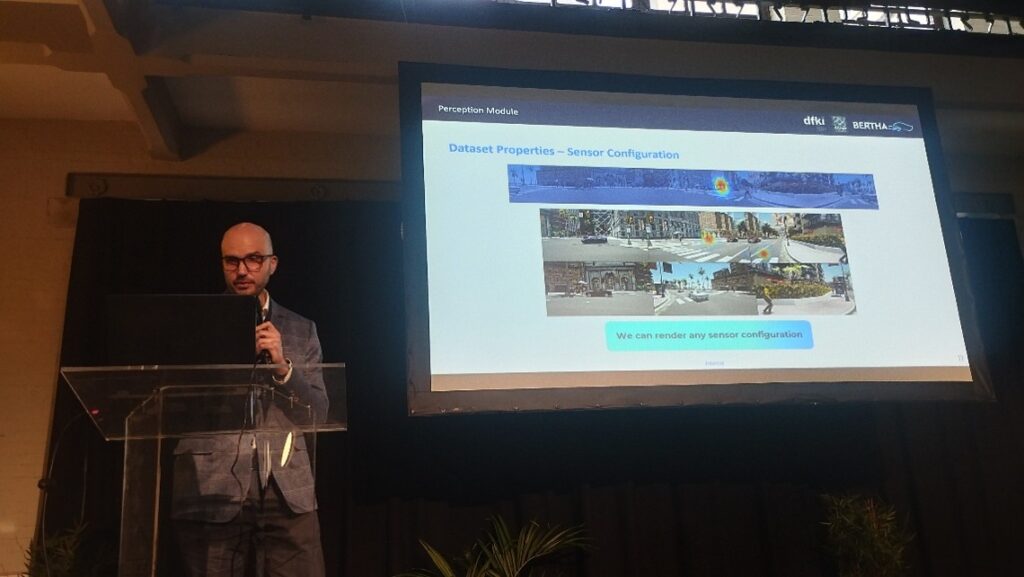
Dr. Jason Rambach presented the perception module developed by the Augmented Vision department. The module models where drivers look and which objects they attend to while driving, and forms part of BERTHA’s Driver Behavioural Model.
The project outcomes from DFKI AV include: DriverGaze360, a large-scale driver attention dataset with a full 360-degree field of view, containing around 1 million gaze-labelled frames recorded from 19 drivers, and DriverGaze360-Net, a panoramic attention prediction network that jointly predicts attention maps and attended objects. The approach achieves state-of-the-art attention prediction on panoramic driving images and was published at CVPR 2026. Code and dataset are openly available.
Project page, code and dataset: https://dfki-av.github.io/drivergaze360/
BERTHA brought together 14 partners from 6 countries with more than €7.9 million in EU funding to develop a probabilistic Driver Behavioural Model that makes connected automated vehicles safer, more predictable and more human-like. The model combines modules for perception, risk awareness, decision-making, affect and motor behaviour, and is made available through an open-source data hub and the CARLA simulator. We thank all partners for three years of excellent collaboration.
Contact: Dr. Jason Rambach